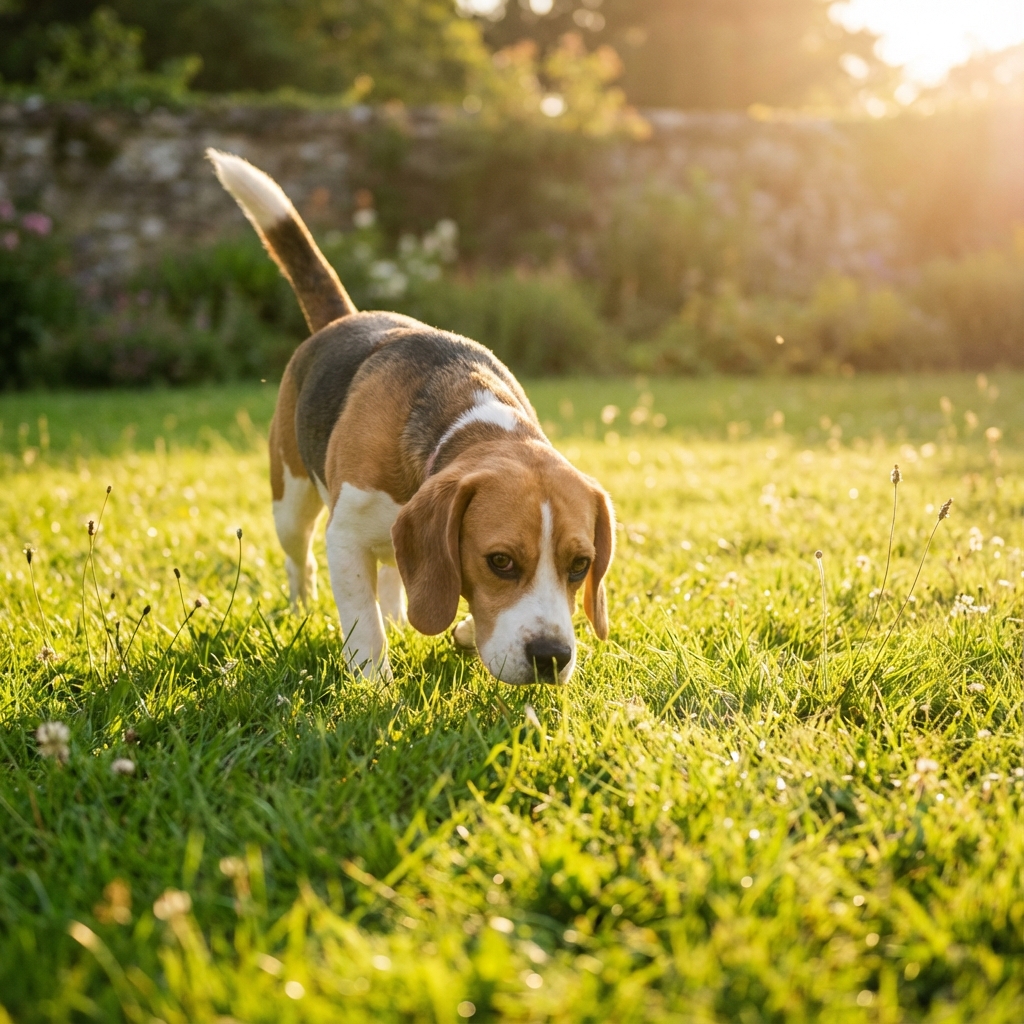
Beagle
The Beagle is a small scent hound developed in England for rabbit hunting, recognized for its exceptional olfactory ability, sociable temperament, and use in modern detection work.
The US Department of Agriculture has a team of Beagles stationed at major international airports. Their job: detecting prohibited agricultural products smuggled into the country—fruits, meats, plants, and other items that could carry foreign pests or diseases. These dogs, known as the Beagle Brigade, have been in operation since 1984. They are considered more effective than X-ray machines for many detection tasks, work 8-hour shifts, and are beloved by the traveling public because they are disarming rather than intimidating.
That is the Beagle in its essence: supremely capable, entirely approachable, and driven by a nose that operates independently of any other input.
The Beagle is one of the most popular dog breeds in the world—consistently top-10 in the US for decades—and for genuinely good reasons. They are the right size for most living situations. They are gentle, sociable, and remarkably good with children. They do not carry the intensity of working-line herders or the physical demands of high-drive sporting dogs. In many ways they are the “Goldilocks” of dogs.
The one thing you cannot work around: the nose runs the show, and the nose does not take days off.
2,000 Years of Scent Work
Small hounds used for hunting hares existed in England before the Roman legions arrived in 55 BC—and the Romans found them already there and worth recording. By the 1500s, English royalty kept packs of “Pocket Beagles” small enough to fit in a hunting jacket pocket. Queen Elizabeth I reportedly kept several.
The modern Beagle was standardized in the mid-19th century, primarily through the work of Reverend Philip Honeywood in Essex, who bred for hunting ability, and Thomas Johnson, who bred for appearance. The two lines merged into the Beagle we recognize. American hunters imported them after the Civil War, and they immediately proved superior rabbit dogs for the terrain and game of the eastern United States.
The AKC recognized the breed in 1885. The Beagle Brigade program, launched nearly a century later, proved that the ancient hunting nose adapted seamlessly to modern detection work—one of the longer continuous employments of any breed’s natural talent in history.
Size and Physical Characteristics
Beagles come in two AKC-recognized varieties:
- 13-inch Beagle: Under 13 inches at the shoulder, weighing 20 lbs or under
- 15-inch Beagle: 13–15 inches at the shoulder, weighing 20–30 lbs
Both have the same character. The size difference only matters for housing and handling preferences.
The physical features of the Beagle are entirely functional:
The long, floppy ears sweep the ground and funnel scent upward toward the nose when the dog has his head down tracking. They are not decorative.
The white-tipped tail was deliberately bred in—hunters needed to see their dogs in tall grass, and the white flag of the moving tail gave them a visual fix. Every Beagle, regardless of other coloring, should have that white tip.
The eyes are large, brown or hazel, and carry the classic warm, slightly pleading hound expression that has melted hearts for centuries.
Colors include the classic Tricolor (black saddle, tan, and white), Red and White, Lemon and White, and Blue Tick, among others. Any “true hound color” is acceptable.
The Nose, Honestly Described
A Beagle has approximately 220 million scent receptors. Humans have about 5 million. When a Beagle acquires a scent—particularly a rabbit, a squirrel, or something interesting on the ground—a neurological event occurs that effectively overrides most other input. Your voice becomes background noise. Your recall commands become conceptually distant abstractions. The dog is working.
This is not stubbornness, exactly. It is the intended design of the breed, and it should inform every outdoor management decision you make from the first day of ownership:
Beagles cannot be trusted off-leash in unsecured areas. Not most Beagles. Not well-trained Beagles. Not your specific Beagle who “usually comes back.” A scent trail in full activation makes reliable recall essentially impossible. Secure fencing and leash discipline are non-negotiable tools of responsible Beagle ownership.
Temperament and Pack Life
Beagles were bred to work in large packs of dozens of dogs. They have no concept of themselves as solitary animals. They want company—other dogs, human family members, anything. A Beagle left alone all day will express his distress vocally. The Beagle bay—a long, carrying howl that covers considerable distance—is the vehicle for that expression. This makes apartment living with thin walls a potential problem.
With family, they are warm, playful, and unfailingly gentle. They are sturdy enough to handle enthusiastic children and temperamentally patient enough to tolerate being dressed up, carried, and generally manhandled (within reason). They are almost universally sociable with other dogs.
One food-related note: Beagles have very limited internal regulation around food. They will eat until ill if given the opportunity. They will counter-surf, raid trash cans, and charm food from guests with professional-level pathos. Weight management requires active owner intervention throughout their lives—free feeding is not appropriate for this breed.
Exercise and Training
Daily exercise: a minimum of 60 minutes of active walking, ideally structured as true sniff-walks where the dog can put his nose down and explore. Controlled sniffing is deeply mentally fatigue-inducing for scenthounds—30 minutes of active nose-work is roughly equivalent to 90 minutes of walking for most other dogs.
Dog sports offer excellent outlets: Beagles excel at AKC Scent Work, Barn Hunt, field trials, and pack hunting events.
Training works best with high-value food rewards and patience for a dog who will absolutely not comply when there’s a competing scent in the environment. Keep sessions short (8–10 minutes), food-heavy, and low-distraction until foundational behaviors are solid.
Health
Lifespan: 12–15 years—notably long for a dog that eats everything it can find.
Key health points:
- Obesity – the #1 risk by a significant margin. Measure every meal.
- Ear infections – deep, floppy ears trap moisture; clean ears weekly, especially after any water exposure
- Epilepsy – more common in Beagles than many breeds; DNA testing available for some forms
- Beagle Pain Syndrome (SRMA) – an immune-mediated meningitis causing fever and neck stiffness in young dogs
- Cherry eye – prolapse of the third eyelid gland; surgical correction is typically required
Grooming
Weekly brushing with a rubber grooming mitt keeps shedding manageable. They shed moderately year-round, more heavily in spring and fall. They have a mild but distinct “houndy” odor that regular bathing (every 4–6 weeks) helps manage. Nail trims every 3–4 weeks. Ear cleaning weekly.
Is a Beagle Your Dog?
The Beagle works beautifully for: active families with a securely fenced yard, multi-dog households (they thrive with company), and anyone who finds joy in watching a dog absolutely lose itself in the joy of following a scent.
The Beagle is the wrong choice for: people who want reliable off-leash freedom, people in densely-packed apartments with noise-sensitive neighbors, or people with small pocket pets like rabbits and hamsters (prey drive remains fully operational in domestic life).
The Beagle Brigade dogs retire after their service careers to family homes, where they apparently transition immediately from detecting illegal mangoes at international airports to sleeping on sofas. The nose doesn’t stop working, of course. It never does. But the urgency becomes more manageable.
Related Breeds

Alaskan Klee Kai
The Alaskan Klee Kai is a small, energetic spitz breed developed in Alaska in the 1970s, resembling ...

American Eskimo Dog
The American Eskimo Dog is a Nordic spitz breed descended from German Spitz dogs, known for its whit...

American Hairless Terrier
Smart, spirited, and hypoallergenic, the American Hairless Terrier is a lively companion that thrive...