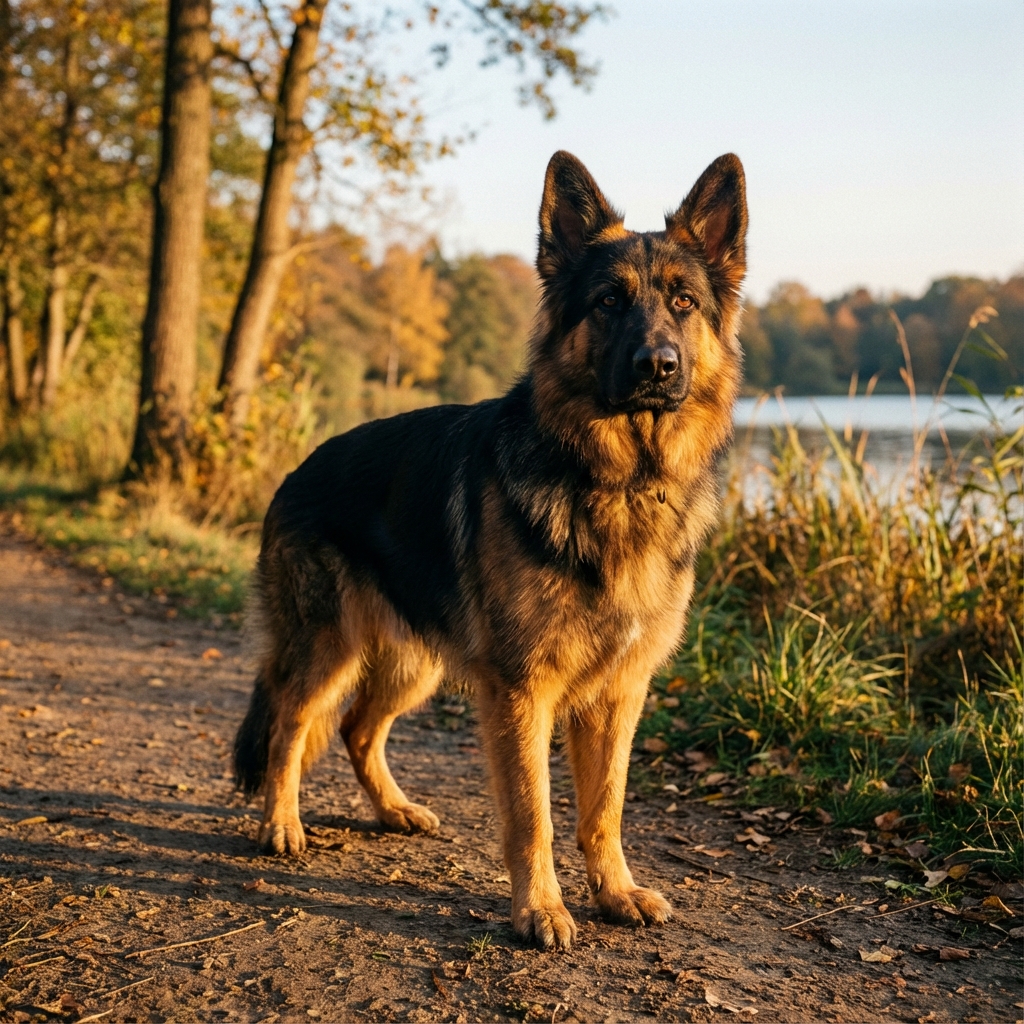
German Shepherd
The German Shepherd Dog is a large working breed developed in Germany in 1899 by Captain Max von Stephanitz, widely used in police, military, search and rescue, and service roles due to its intelligence, trainability, and versatility.
In 1899, a German cavalry officer named Captain Max von Stephanitz attended a dog show and bought a wolf-like dog named Hektor Linksrhein for what seemed like an unreasonable sum. He renamed the dog Horand von Grafrath, declared him the first German Shepherd Dog, and spent the rest of his life building a breed around one obsessive principle: utility over beauty.
Von Stephanitz’s motto was Nutzung und Intelligenz—“Utility and Intelligence.” When Germany industrialized and herding dogs became less commercially valuable, he pivoted the breed immediately to police work, military service, and search and rescue. He died in 1936, having produced a breed that went on to serve in two World Wars, write the playbook for modern K-9 training, and become the most-tested working dog in history.
The German Shepherd is not a pet that also works. It is a working dog that also happens to live in your house. Understanding that distinction makes everything else about the breed make sense.
What He Looks Like
The GSD is a large, athletic dog built for all-day movement—longer than he is tall, giving him a ground-covering trot that looks smooth but covers enormous distances effortlessly.
- Size: Males stand 24–26 inches and weigh 65–90 lbs. Females are slightly smaller at 22–24 inches and 50–70 lbs.
- Coat: A dense double coat with a harsh outer layer and soft undercoat. Sheds year-round, blows coat heavily twice a year. Owners call them “German Shedders” for a reason.
- Colors: Black and Tan is the most recognized, but Sable (the working dog’s traditional color), All-Black, and Bi-Color (mostly black with brown legs) are all common and equally correct.
One thing worth knowing before you buy: there is a significant difference between show-line and working-line German Shepherds. Show lines (particularly American show lines) have been bred for extreme hindquarter angulation—the sloping back that has become visually iconic but is functionally controversial and associated with higher rates of hip dysplasia and movement issues. Working lines (West German, Czech, DDR/East German) maintain a straighter back and a more functional build. If you want a dog that can actually work, or simply a dog built for physical soundness, working lines are worth specifically seeking out.
The Character Underneath
The GSD standard describes a dog that should stand its ground with quiet confidence—an “approachable” dog, but one that doesn’t surrender that ground easily. This is not a breed that greets strangers like they’re long-lost friends. He assesses. He watches. He gives his trust slowly, and once given, it is absolute.
His protectiveness is not trained in—it arrives factory-installed. What needs to be trained is discrimination: understanding the difference between a genuine threat and a postal worker doing their job. Without extensive socialization from puppyhood forward, this natural protective instinct can shade into fear-based reactivity. Thousands of shelter GSDs owe their situation to owners who thought the protectiveness was charming and skipped the socialization.
He is ranked #3 in intelligence by most studies—behind the Border Collie and Poodle. But intelligence in a dog is not merely about learning commands quickly; it is about what happens when the dog is not engaged. An unstimulated German Shepherd finds problems to solve. Baseboards. Furniture. The fence line. He needs mental work as much as physical exercise, ideally both simultaneously through activities like tracking, obedience trials, Schutzhund/IGP, or nosework.
What Daily Life Actually Requires
Exercise: 90 minutes to 2 hours of vigorous daily activity. This cannot be mostly a walk—walks are maintenance, not exercise, for a GSD. He needs to run, retrieve, work through obedience patterns, or train in a sport. A GSD who receives 30 minutes of slow-lead walking and then sits alone in an apartment for 10 hours will dismantle that apartment with impressive thoroughness.
Training: Not optional. An 80-pound untrained German Shepherd is a safety liability. Training should begin the day the puppy arrives home. GSDs are responsive to firm, fair, consistent positive reinforcement. Harshness produces a dog who shuts down or becomes anxious. The breed learns fast—both good behaviors and bad habits.
Socialization: Begin immediately. The socialization window (8–16 weeks) is critical. Puppy classes, public outings, exposure to people of many ages and appearances, other dogs, bicycles, loud noises, crowd environments. Gaps in early socialization show up later as reactivity that is far harder to address.
Health Realities
Typical lifespan: 10–13 years.
The breed’s popularity has not been kind to its health. Irresponsible breeding has elevated the rates of several serious conditions:
- Hip and Elbow Dysplasia: The most notorious health issue. Request OFA evaluations for both parents before purchasing. Show-line dogs have historically higher dysplasia rates than working lines.
- Degenerative Myelopathy (DM): A progressive neurological disease that causes gradual paralysis of the hindquarters—similar in progression to ALS in humans. A DNA test is available to identify carriers and affected dogs.
- Bloat (GDV): The deep chest puts GSDs at elevated risk. Feed two meals daily, use a slow-feeder bowl, avoid vigorous exercise within an hour of eating.
- Panosteitis: Painful inflammation of the long bones in puppies, causing shifting lameness. Usually resolves as the dog matures.
- Exocrine Pancreatic Insufficiency (EPI): A condition where the pancreas fails to produce sufficient digestive enzymes. Manageable but requires lifelong enzyme supplementation.
Grooming
Straightforward but relentless. Brush 3–4 times per week with a slicker brush and undercoat rake—daily during the two annual heavy shedding seasons. Bathing every 6–8 weeks preserves the coat’s natural oils. Nail trims every 3–4 weeks. Ear checks weekly.
Invest in a good vacuum. There is no alternative.
The Honest Fit Assessment
The GSD is not a casual commitment. He is right for someone who runs or hikes daily, who has genuine interest in training as an ongoing activity, and who understands that this dog wants to participate in life—not watch it from a crate.
For that person, there is no more capable, loyal, or rewarding companion in the working dog world. Von Stephanitz spent nearly 40 years building this dog. He got it right.
Related Breeds

Greyhound
Der Greyhound ist ein uralter Sichthund, der Sprintgeschwindigkeiten von bis zu 72 km/h erreicht. Di...

Afghan Hound
The Afghan Hound is an ancient sighthound from the mountains of Afghanistan, known for its long, sil...

Akita
With their massive heads, curled tails, and silent strength, the Akita is a loyal, dignified protect...