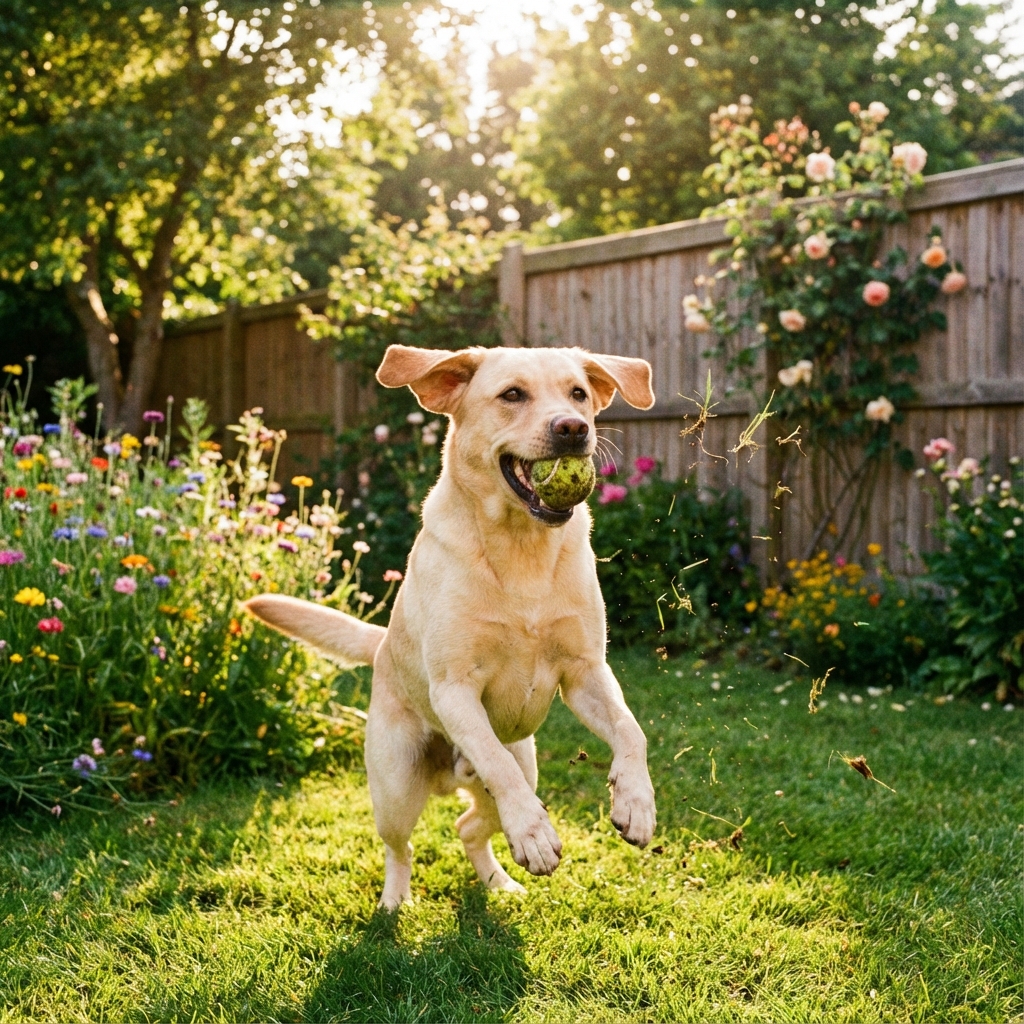
Labrador Retriever
The Labrador Retriever is a large sporting breed originating from Newfoundland, Canada, where it was used by fishermen to retrieve nets and fish from cold Atlantic waters. It is widely used as a guide dog, detection dog, and therapy dog, and has been among the most registered breeds in the United States for multiple decades.
For 31 consecutive years—from 1991 to 2021—the Labrador Retriever was the most registered dog breed in the United States. No other breed in AKC history has held that position for anything close to that long. In 2022, the French Bulldog finally knocked them off the top spot. The Lab responded by remaining comfortably in the top three, as if entirely unbothered.
This durability has a simple explanation: the Labrador Retriever is really, genuinely good at being a dog.
Not in a spectacular, specialized way. Not in a “this breed does one thing better than anything alive” way. The Lab is the Swiss Army knife. He is a family companion who tolerates children’s chaos with patient good humor. He is a gun dog who retrieves waterfowl from freezing lakes with operational efficiency. He is the most widely used guide dog breed in the world—the temperament that allows a dog to navigate city traffic while remaining calm, responsive, and unflappable is not common, and the Lab has it in abundance. He detects cancer in medical trials. He sniffs out explosives and narcotics for law enforcement. He visits hospitals as a therapy dog. He does all of it.
The challenge of owning a Labrador is not that they are difficult. It’s that their cheerful enthusiasm and enormous affection can run away from you if you don’t channel it properly.
Where They Actually Come From
Despite the name, Labradors did not originate in Labrador. They came from Newfoundland, Canada, where they were known as St. John’s Dogs in the 1700s. These early ancestors worked alongside fishermen—jumping into freezing Atlantic waters to retrieve fishing nets and escaped fish, swimming lines between boats, and providing the kind of cold-water endurance that their modern descendants still carry in their genes.
Visiting English nobility spotted these dogs in the early 1800s and brought them back to the UK, where they were refined into sporting retrievers by the aristocracy. The Earl of Malmesbury is credited with first calling them “Labrador Dogs” to distinguish them from the larger Newfoundland breed. The breed was officially recognized by The Kennel Club in 1903 and by the AKC in 1917.
What He Looks Like
The Lab is a medium-to-large dog built for swimming and for work that requires sustained effort over long periods.
- Size: Males stand 22.5–24.5 inches at the shoulder and weigh 65–80 lbs. Females: 21.5–23.5 inches and 55–70 lbs.
- The Otter Tail: Thick at the base, tapering to a point, and almost constantly in motion. Functions as a rudder when swimming. Also functions as a surface-clearing instrument at coffee table height.
- Webbed feet: Genuinely webbed, not metaphorically. They are efficient, purpose-built swimmers.
- Double coat: A short, dense outer coat with a weather-resistant, almost waterproof undercoat. Sheds consistently and blows coat heavily twice a year. A good vacuum is a non-negotiable purchase.
- Colors: Three only—Black (the original working color), Yellow (ranging from pale cream to fox-red), and Chocolate (medium to dark brown). Silver and “charcoal” Labs exist but are genetically diluted Chocolates.
The Lab Personality, Honestly
The standard phrase is “friendly and outgoing.” The honest phrase is “enthusiastically and sometimes insufferably social.” Labs do not have stranger danger. They do not assess new people. They assume—with complete and never-shaken confidence—that every new person they meet is a potential belly-rub provider and treats this as a good thing.
This makes them catastrophically bad guard dogs. It also makes them wonderful with children, welcoming to guests, and easy to take anywhere in public.
The energy of a Lab puppy is legitimately startling to first-time Lab owners. Labs don’t mentally mature until they’re approximately 3 years old. The body reaches adult size by 12–18 months. The mind takes another year or two to catch up. This gap—a physically powerful adult-sized dog with the impulse control of a very enthusiastic teenager—is the period that sends many Labs to shelters. Leash training, impulse control work, and basic obedience must begin immediately and continue consistently.
A tired Lab is genuinely easy to live with. An under-exercised Lab—bored, pent up, and full of energy that has nowhere useful to go—is not. They are not a destructive breed by temperament. They become destructive by circumstance.
Food: The Lab’s Defining Vulnerability
This deserves its own section.
Labradors possess a gene variant in the POMC gene that many other dog breeds do not have. This variant impairs the dog’s ability to feel satiated—their hunger signals do not normalize after eating the way they do in most breeds. A Lab will eat as much as you put in front of them, every time. They will eat from the trash. Counter-surf. Steal from children. Accept food from strangers. Consume things that are not food if food is unavailable.
Obesity is the #1 health problem in the Labrador breed. It worsens joint problems, shortens lifespan, and reduces quality of life significantly. Strict portion control—measured by weight, not by cup—is essential for the entire life of the dog. Free feeding is not appropriate. High-calorie treats should be replaced with low-calorie alternatives (carrot pieces, green beans) during training.
Exercise
Labs need at least 60–90 minutes of vigorous daily exercise. Not a slow walk—retrieving, running, swimming, or active play. Swimming is an ideal low-impact option for older Labs or those with joint issues. Fetch is essentially genetic for the breed.
Sports that work especially well: hunting retrieval, dock diving, AKC tracking, field trials, and therapy dog work.
Health
Lifespan: 10–12 years.
- Hip and Elbow Dysplasia: Common. Always request OFA evaluation results from both parents before purchasing.
- Exercise Induced Collapse (EIC): A genetic condition where intense exercise triggers muscle weakness and collapse. DNA test available.
- Obesity: Addressed above. Non-negotiable management issue.
- Bloat (GDV): The deep chest creates elevated risk. Two smaller meals daily, slow-feeder bowl, no vigorous exercise within an hour of eating.
- Progressive Retinal Atrophy (PRA): DNA test available; request documentation from breeders.
Chocolate Labradors have consistently shown shorter lifespans in studies than Black and Yellow Labs—averaging about 10% shorter. The genetic bottleneck created by selective breeding for the chocolate color appears to be the contributing factor.
Why 31 Years?
The Labrador Retriever held the top spot for so long not by being novel or specialized or dramatic. He held it by consistently being exactly what most families needed: kind, tolerant, trainable, active without being extreme, and functional across a wide range of roles.
He is not a highly specialized breed. He does not have the Belgian Malinois’s drive intensity, the Poodle’s problem-solving speed, or the Bloodhound’s scenting ability. What he has is a consistently reliable all-around temperament that suits the demands of everyday family life.
That combination proved sufficient to hold the top registration spot for three decades.
Related Breeds

Greyhound
Der Greyhound ist ein uralter Sichthund, der Sprintgeschwindigkeiten von bis zu 72 km/h erreicht. Di...

Afghan Hound
The Afghan Hound is an ancient sighthound from the mountains of Afghanistan, known for its long, sil...

Akita
With their massive heads, curled tails, and silent strength, the Akita is a loyal, dignified protect...